
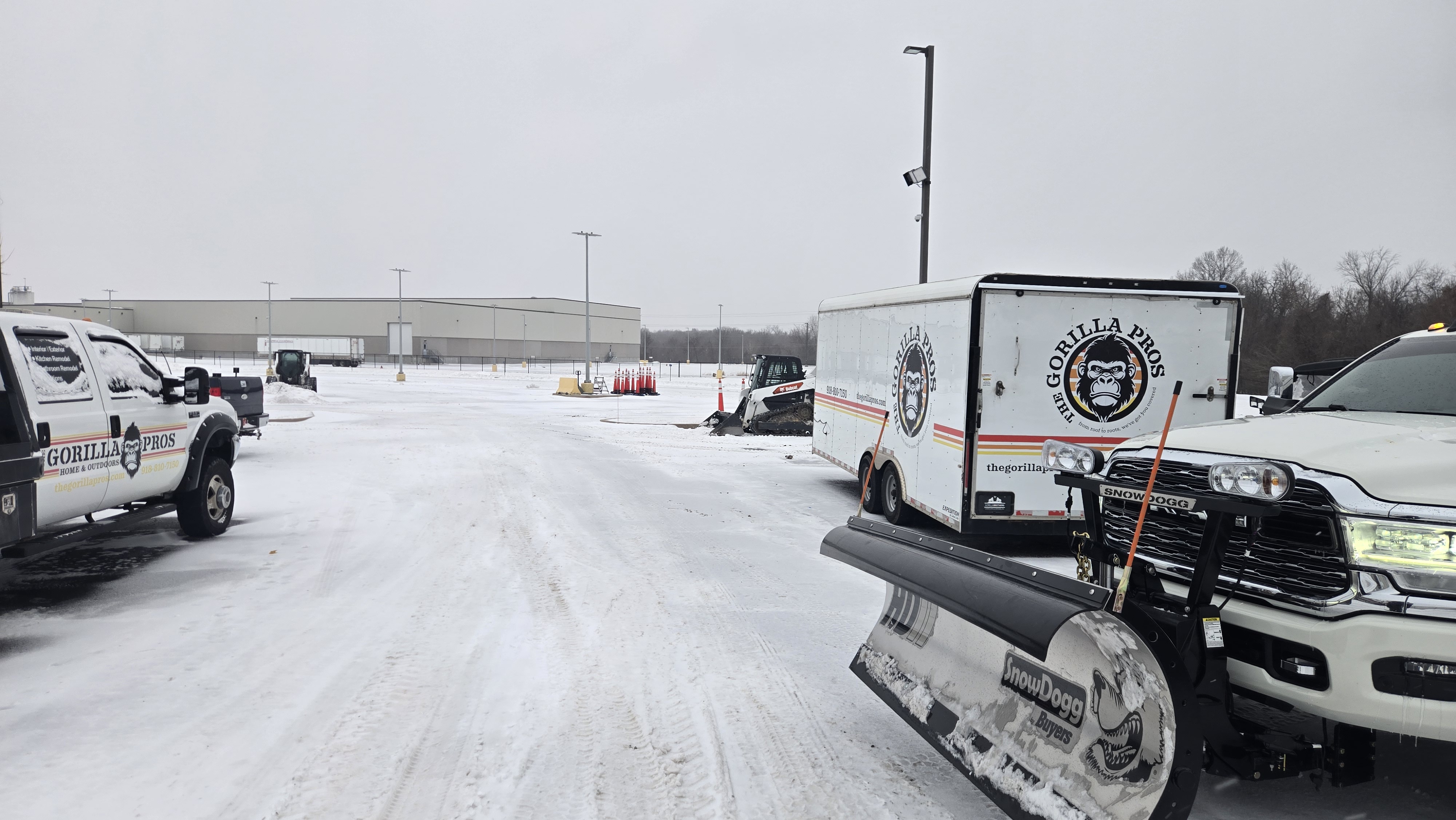
For owner Mike Buerker, professional snow and ice work in the Tulsa area goes back to 2009. Over the years, that has meant plenty of Oklahoma winter nights behind a plow, managing crews and equipment, applying deicer, watching forecasts change, and learning firsthand what works—and what doesn’t—when you’re responsible for keeping commercial properties accessible.
Some winters barely give the plows a workout. Others bring snow, sleet, ice, refreeze, and long nights that test even the best plan.
And after all those winters, one lesson stands out:
The best commercial snow and ice management doesn’t start when the snow starts falling. It starts well before the storm.
For commercial properties in Tulsa and the surrounding area, winter preparedness isn’t simply finding someone with a plow and calling when the forecast turns white. The properties that are easiest to service—and the relationships that tend to work best—are the ones where the facility and snow contractor have already walked the site, discussed expectations, identified priorities, and talked honestly about what happens when Mother Nature doesn’t cooperate.
So, from the perspective of the people who may be out there at 2:00 a.m. plowing your parking lot, here are a few things we’ve learned over the years.
Walk the Property Before You Ever Need a Plow
If there’s one thing we’ve learned, it’s that a property walk on a clear day can save a lot of confusion at 2:00 a.m. in a snowstorm.
Before the winter season, meet your commercial snow removal contractor onsite and walk the property together.
Identify entrances and exits, employee and customer parking, loading areas, fire lanes, sidewalks, ADA-accessible areas, curbs, islands, drainage points, dumpsters, equipment, and other obstacles.
Then, put it on a map.
A good site map should show your contractor what needs to be serviced, what takes priority, where potential hazards are located, and where snow can—and cannot—be piled.
For larger commercial and industrial properties, one walkthrough may not be enough. Conditions change. Construction happens. Equipment gets moved. Parking patterns change.
When significant winter weather is approaching, there can also be value in communicating again and, when appropriate, meeting onsite shortly before the storm. A quick review of the plan can make a big difference once conditions deteriorate.

Tell Us What You Expect Before the Storm
There isn’t one universal definition of a “clear” commercial parking lot.
Does your facility need to remain fully operational throughout the storm? Do you primarily need main drives and entrances maintained while precipitation is falling, with a more thorough clearing afterward?
What about employee parking? Customer parking? Loading docks? Sidewalks? Entrances? Secondary lots?
Those expectations need to be discussed before the storm—not discovered halfway through it.
Expectations also need to be weighed against budget.
Keeping a large commercial facility continuously serviced during a prolonged winter storm requires more equipment, labor, fuel, and deicing material than allowing some accumulation and performing fewer service cycles.
That doesn’t make one plan right and another wrong. It means the contractor and customer need to agree on a level of service that makes sense for the property, its operations, and its budget.
The important part is making those decisions before everyone is watching the radar.
Have a Plan for When Mother Nature Wins

We’ve worked enough Oklahoma winter storms to know that sometimes Mother Nature simply wins for a while.
There are events where snow, sleet, or ice is coming down faster than crews can effectively keep up with it.
We can plow. We can shovel. We can apply material. We can make another pass.
And sometimes the weather covers it right back up.
That’s why one of the most important conversations a commercial facility can have before a winter storm is simple:
What is our Plan B if conditions temporarily exceed what anyone can reasonably keep clear?
If your facility normally operates throughout winter weather, determine beforehand whether you can temporarily close an entrance, reduce traffic to certain areas, delay a shift change, consolidate parking, partially shut down, or, in extreme circumstances, temporarily close the facility.
Sometimes giving snow and ice crews the time and space to catch up after precipitation slows or stops is the safest and most effective option.
Your commercial snow removal contractor can work to maintain the property during the storm, but every business should also have an operational plan for severe weather.
Decide Where the Snow Is Going
This sounds obvious until you have a parking lot full of snow.
Every plow pass moves snow somewhere, and on a large commercial property those piles can become very large, very quickly.
Before the season starts, identify acceptable snow-storage areas.
Think about visibility at entrances and intersections, parking capacity, fire hydrants, loading areas, sidewalks, accessible routes, and drainage.
Also identify where you absolutely do not want snow piled.
And ask another important question:
What happens if we run out of room?
During larger or repeated snow events, snow may eventually need to be relocated onsite or hauled away.
Knowing where snow should go before the first plow arrives allows crews to work more efficiently and helps prevent today’s snow pile from becoming tomorrow’s problem.
The Storm Ending Doesn’t Mean the Job Is Finished

In Oklahoma, sometimes the bigger problem comes after the snow stops.
Temperatures rise. Snow and ice begin to melt. Water moves across the property.
Then the temperature drops again.
What was wet pavement in the afternoon can become ice overnight.
Thaw and refreeze should be part of your commercial ice management plan from the beginning.
Identify areas prone to drainage or refreezing and determine what you expect from your contractor after the initial storm.
Should the property be checked again overnight or the following morning? Are there known areas that may need additional deicing treatment? Who has authority to approve additional service?
And don’t forget about snow piles themselves. As piles melt, water can travel across parking lots and drives before refreezing somewhere else.
Those questions are much easier to answer beforehand than when employees are arriving the next morning.
Know What Is Being Put on Your Property

Salt, ice melt, and other deicing products aren’t all the same.
Products can differ in cost, effective temperature range, application needs, and their potential effects on the surfaces and surroundings where they’re used.
The least expensive product isn’t necessarily the best solution for every property or every storm. At the same time, the most expensive product isn’t automatically necessary everywhere.
There are tradeoffs.
Repeated exposure to deicing materials can affect concrete, masonry, metals, landscaping, and other materials. Those products can also be tracked into a building on shoes, carts, and equipment.
Talk with your contractor about what they’re using, why they’re using it, where it will be applied, and what alternatives are available.
A good commercial ice management plan should balance conditions, performance, property concerns, expectations, and budget.
The goal isn’t simply to put down as much material as possible. It’s to use an appropriate product and application strategy for the conditions and the property.
Don’t Stop Planning at the Front Door
Something else we’ve learned over the years: what happens outside eventually finds its way inside.
Employees, customers, vendors, and visitors track in snow, water, slush, salt, and deicing residue.
Before winter weather arrives, take a look at your entrances.
Do you have adequate commercial floor mats? Are they large enough for the amount of traffic entering the building? Who is responsible for checking wet floors and replacing or drying saturated mats during a prolonged event?
Also consider what happens after the storm.
Deicing residue, moisture, and dirt may require additional interior cleaning once conditions improve. Depending on your facility, that may need to be incorporated into your winter-weather procedures.
A cleared parking lot doesn’t help much if the entrance immediately inside the building creates another problem.
Give Your Contractor One Person to Talk To
Communication during a winter event matters.
Before the storm, designate someone who understands the facility’s operations, the agreed-upon snow and ice plan, and the property’s priorities.
If conditions change, your contractor may need quick answers.
Can vehicles be moved?
Can an area temporarily close?
Has the facility changed its operating hours?
Should another deicing treatment be performed?
Do service priorities need to change?
Having one knowledgeable decision-maker available can make winter operations considerably more efficient.
It also allows crews in the field to spend more time servicing your property and less time trying to figure out what you want them to do.
Commercial Snow & Ice Planning Checklist
Before winter weather arrives, schedule a conversation with your snow and ice contractor and walk the property together.
Use this checklist to help guide that conversation.
Property & Site Planning
☐ Have we walked the property together before the winter season?
☐ Do we have an up-to-date site map showing the areas to be serviced?
☐ Which entrances, drives, parking areas, loading areas, and sidewalks are highest priority?
☐ Are there curbs, islands, drains, fire hydrants, equipment, dumpsters, or other obstacles the contractor needs to know about?
☐ Where should snow be piled?
☐ Where should snow never be piled?
☐ What happens if designated snow-storage areas become full?
☐ Could snow relocation or hauling be necessary?
Service Expectations
☐ What conditions or accumulation trigger service?
☐ Does the property need to remain fully operational while snow or ice is actively falling?
☐ What level of clearing do we expect during the storm versus after it ends?
☐ Are sidewalks and pedestrian areas included?
☐ Which areas should be serviced first?
☐ How frequently do we expect service during a prolonged winter event?
☐ Do our expectations realistically align with our winter-weather budget?
Severe Weather & Facility Operations
☐ What is our Plan B if snow or ice is accumulating faster than it can reasonably be cleared?
☐ Can certain parking areas or entrances temporarily close?
☐ Can employee or customer traffic be redirected?
☐ Can shift changes or operating hours be adjusted if necessary?
☐ Who makes the decision to partially or fully close the facility?
☐ Once precipitation slows or stops, can we give the snow contractor enough access to perform a more complete cleanup?
Ice, Deicing & Refreeze
☐ What type of salt or deicing product will be used?
☐ Why is that product appropriate for our property and expected conditions?
☐ What are the differences in cost and performance between available products?
☐ Are there concrete, masonry, metal, landscaping, or other surfaces we’re particularly concerned about?
☐ Are there areas of the property that commonly hold water or refreeze?
☐ What is the plan for thaw and refreeze after the storm?
☐ Do we expect post-storm monitoring or additional treatment?
Inside the Facility
☐ Do we have adequate commercial entrance mats?
☐ Who will monitor wet floors and saturated mats during the storm?
☐ How will tracked-in salt, ice melt, moisture, and debris be handled?
☐ Will additional interior floor cleaning be needed after the event?
Communication
☐ Who is the primary facility contact during a winter-weather event?
☐ Does the contractor have that person’s current contact information?
☐ Who has authority to approve additional services or material applications?
☐ How will changes in operating hours or property priorities be communicated?
☐ When significant weather is forecast, should we have a pre-storm call or onsite meeting?
One Final Question
☐ If the forecast is wrong and the storm becomes significantly worse than expected, does everyone know what Plan B is?
Print, save, or share this checklist with your facility team and snow and ice contractor before the winter season. A few conversations on a clear day can prevent a lot of confusion when the weather turns.
And One More Thing: We’re Human. And We’re Cold.


This one probably doesn’t appear on many commercial snow removal checklists, but after years of doing this work, we think it’s worth talking about.
During a significant winter event, the people servicing your property may be working extremely long hours in some pretty miserable conditions.
They’re cold. They’re tired. Visibility can be terrible. Roads between properties may be difficult to travel. Equipment gets covered in snow and ice. Trucks and equipment occasionally break. And the forecast we all planned around can change.
None of that means expectations don’t matter.
They absolutely do.
It simply means communication and a little grace go a long way during a major weather event.
The facility manager inside the building and the operator sitting in the plow ultimately want the same thing: to keep people safer, keep the property accessible, and keep your operation running as effectively as conditions allow.
The best commercial snow relationships we’ve had over the years have always felt like exactly that—a relationship.
We’re working toward the same goal.
Commercial Snow Removal & Ice Management in Tulsa
After many Oklahoma winters, we certainly don’t pretend we can predict exactly what Mother Nature is going to do.
What we can do is prepare.
We can walk the property. We can make a map. We can identify priorities and snow-storage areas. We can discuss products, service levels, and budgets. We can understand your operation before the storm arrives.
And when conditions inevitably change, we can communicate and adjust the plan together.
At Gorilla Brothers Renovations, our team’s professional experience with snow and ice service in the Tulsa area goes back to 2009. Today, we provide commercial snow removal, commercial snow plowing, salt application, deicing, snow hauling, and ice management services for businesses and facilities throughout Tulsa and the surrounding area.
If you’re responsible for a commercial property, industrial facility, office, retail property, or other business in the Tulsa area, before the first winter storm is the best time to start the conversation.
We’re currently preparing for the 2026–2027 winter season and working with local businesses, property managers, and facility teams to develop winter service plans for their properties.
Contact The Gorilla Brothers to discuss commercial snow removal and ice management for your Tulsa-area property.
Leave a Reply